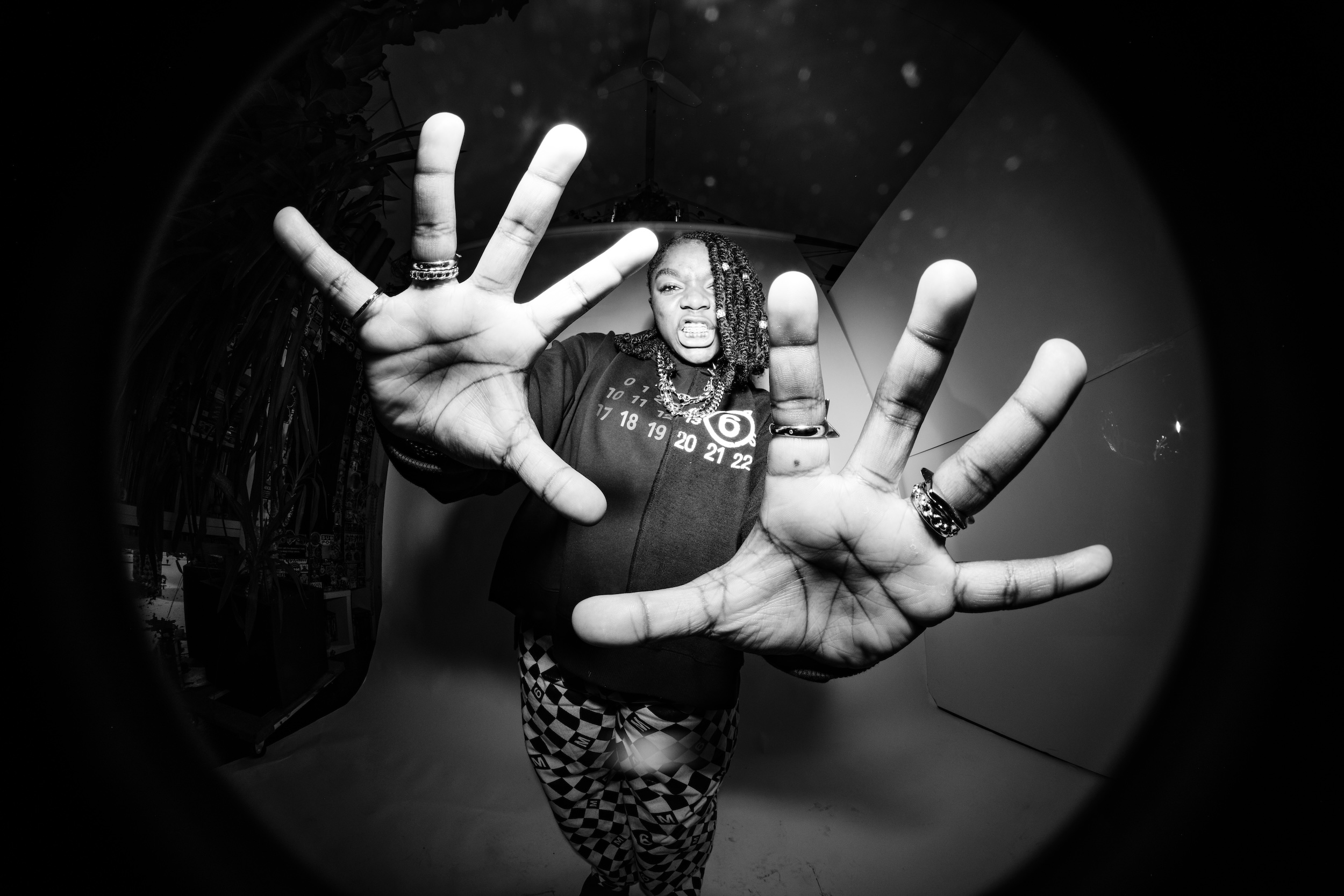
There’s certainly no shortage of artists borrowing from the aesthetics of past decades, but nostalgia alone rarely makes a convincing record. Thankfully, UCHAYE avoids that trap on ‘WAR IS OV3R’.
The Minneapolis artist clearly has an affinity for the grand melodic instincts of 80s rock and the guitar-led songwriting associated with figures such as Joan Jett, David Bowie, and Bruce Springsteen. Yet the EP never feels like an attempt to recreate a specific historical moment. Instead, those influences provide a vocabulary through which she tells a much more personal story.
The EP begins with ‘Denial (Interlude)’, a short atmospheric piece that creates immediate unease. ‘Denial’ then follows by examining emotional fixation at close range, with the central character becoming increasingly unable to separate memory from desire.
The shift into ‘Survive’ is one of the EP’s strongest moments. The arrangement gains weight and forward movement, reflecting a change in mindset as she begins cutting ties with what she had been clinging to.
‘Currency’ then introduces a different kind of tension. Heartbreak has receded, but emotional openness hasn’t returned with it. Instead, material success and authority become substitutes, suggesting that self-reinvention can be just as dangerous as self-destruction when driven by unresolved hurt.
Finally, ‘Live Wire’ throws open the windows. Its swaggering flavour brings Jimi Hendrix into the wider frame of influence, but the appeal lies in the way she uses that vocabulary to create release. The closer sounds bigger because the character has herself become bigger.
There’s also a confidence in the EP’s restraint. At just five tracks, UCHAYE doesn’t over-explain her concept. Each song has a clear role and the EP ends before the idea begins repeating itself.
And for a debut EP, that discipline is impressive. ‘WAR IS OV3R’ suggests an artist who has studied the mechanics of enduring rock songwriting but understands that influence only becomes useful once it’s transformed into something individual. UCHAYE isn’t looking backwards for escape. She’s using the past as raw material for her own arrival.