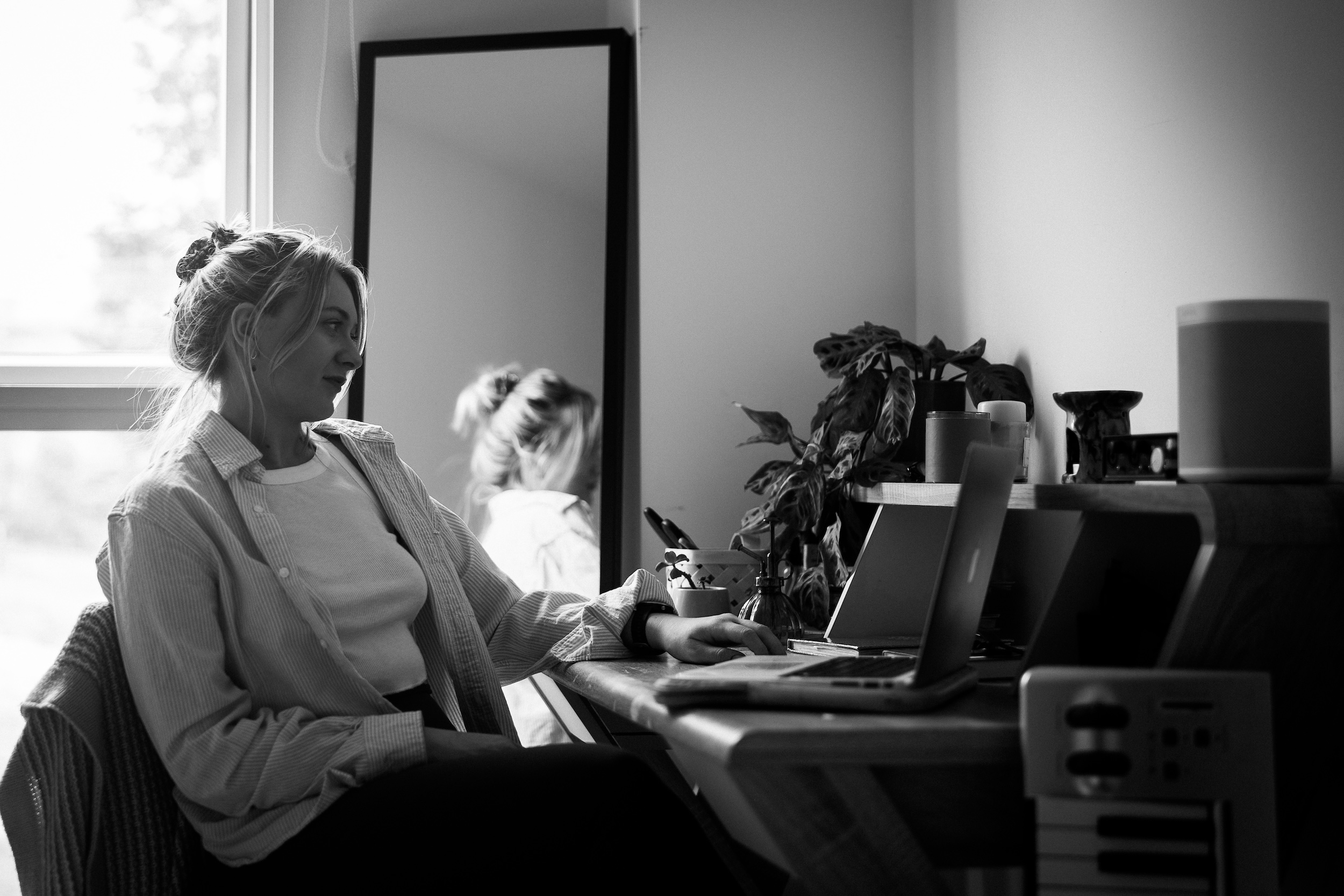
London-based vocalist and composer Rowan Flack returns with her forthcoming third EP ‘Nap on the Sofa’, a project that further refines her distinctive blend of contemporary European jazz and folk-inflected songwriting. With a background spanning the BRIT School, Trinity Laban, and Norway’s Edvard Grieg Academy, Flack brings a rich, international perspective to her music, one that continues to evolve with each release.
Opening with the delicate and dreamlike ‘Make Me Whole’, the EP unfolds with a quiet intimacy before drifting into the title-track, a tender reflection on modern romance, elevated by an expansive piano solo and the conversational interplay of her band. Closing track ‘Tipsy’ adds a textured, introspective edge, weaving together jazz, folk, and subtle pop sensibilities to explore emotional duality and life’s unpredictable rhythms.
Recorded with a collective of accomplished musicians from across London, Bristol, and Ireland, the EP captures a live, organic energy that mirrors her onstage presence. With previous acclaim from Jazzwise, Jazz FM, and Notion, and a growing reputation across the UK and European jazz scenes, she continues to carve out a compelling artistic space.
We caught up with Rowan Flack to discuss the inspiration behind Nap on the Sofa, and how her journey through jazz, folk, and storytelling continues to shape her sound.
–
Can you tell us a bit about your musical background and how you got started in music?
I started writing music on the piano at home when I was around seven. They weren’t really ‘songs’, but playing around and creating my own way of notating things gave me the freedom to just enjoy the process.
A few years later, around ten, my parents bought me an acoustic guitar for about five pounds – I actually still have it. From that point on, I was completely set on music. I’d make my friends perform in school assemblies with me and take any opportunity to write or perform. Developing material and letting it evolve is what I love most – it’s the thing that feels most natural to me.
I’m really grateful for my time at The BRIT School, studying jazz at Trinity Laban Conservatoire, and later folk and jazz at the Edvard Grieg Academy in Norway. Each of those experiences gave me the space to develop and refine my musical direction.
Who are some of your biggest musical influences, both past and present?
I love the vocal and compositional styles of artists like Rita Payés, Gretchen Parlato, Norah Jones, and Astrud Gilberto. But one of the biggest influences on me was Keith Jarrett and Jan Garbarek’s album Belonging, which my piano teacher lent me when I was 14. I played it on repeat in my bedroom, and it really shaped my love for that ECM-style European jazz soundscape that I now try to explore in my own writing.
Are there any specific artists or bands that have had a significant impact on your musical style or approach?
The musicians I currently play with have had a huge impact on my sound and approach. I love how we perform the music live. It feels organic, free-flowing, and driven, particularly through the drums.
I usually write songs at the piano, working from lead sheets, and collaborating with the band has helped me develop an instinct for how the music will sound without needing to fully notate it. That’s been really important in shaping my sound.
Could you share any memorable moments or experiences that have shaped your musical journey so far?
Changes in my creative environment have been some of the most important influences on my development. Studying abroad in Norway through an Erasmus Scholarship scheme was a big one, as was adapting during lockdown – learning how to record from home and finding structure in daily creative routines.
Another defining experience was a residency at a jazz club in China about seven years ago. I took time out of university to do it, and it’s where I began working with the bassist I still collaborate with today. That relationship has been a huge part of my musical journey.
How do you express your personal experiences and identity through your music?
Melodies and harmony tend to come to me first. I often improvise vocally over chordal ideas, and the sounds I make can start to resemble words, which then guide the lyrics.
Because of that, I think my personal experiences come through quite subconsciously. Having a sense of identity in your music is really important to me, especially in jazz and folk contexts, otherwise everything risks sounding the same.
Have you faced any challenges or obstacles as a female musician, and if so, how have you overcome them?
When I first started studying jazz, there was a noticeable divide between the ‘jazz musician’ and the ‘jazz singer’, which I found challenging. I think this has changed a lot now, but at the time, I struggled with certain improvisational approaches that instrumentalists were using, and it’s easy to internalise that and think, “I can’t do that.” But over time, I realised that people learn differently, and that those methods don’t necessarily translate easily across disciplines. Developing my own way of approaching improvisation and allowing space for freedom and expression helped me to find confidence in my abilities.
Are there any themes or messages that you aim to convey through your music?
Hope, understanding, and patience.
Can you talk about your creative process and how you go about writing and producing your music?
I usually start at the piano, improvising until I find something that resonates. From there, I’ll layer vocal ideas on top, often shaping lyrics through sound and rhythm first. I also keep notebooks with fragments of lyrics or ideas, often written while travelling, which I’ll return to if I feel stuck.
Thematically, my music often explores nature, growth, and inner strength. Sometimes this is through relationships, sometimes through more internal struggles like communication. The natural world is a big source of inspiration lyrically.
When recording, I love maintaining an authentic, intimate sound. I loved how we recorded the latest EP, Nap on the Sofa – all in one studio, a couple of takes – live drums with big cymbals, acoustic bass, improvised piano solos, and interwoven lines between trumpet and voice.
I’ve experimented with more produced sounds in my own music, but lately I’ve been drawn back to that raw, live sound.
How do you hope your music will resonate with your audience, especially with other aspiring female musicians?
I feel incredibly grateful to work fully within music and audio, through radio with BBC Radio 3 and One Jazz, as well as my work as a writer and musician with Pretty Decent Music. I also mentor students at East London Arts and Music, which I love doing. If I had one piece of advice, it would be not to box yourself into a genre. Some of the work I’m most proud of has been the most experimental, instrumental pieces, extended solos – things that didn’t necessarily fit expectations.
–
Listen to Rowan Flack’s new EP ‘Nap on the Sofa’ below.