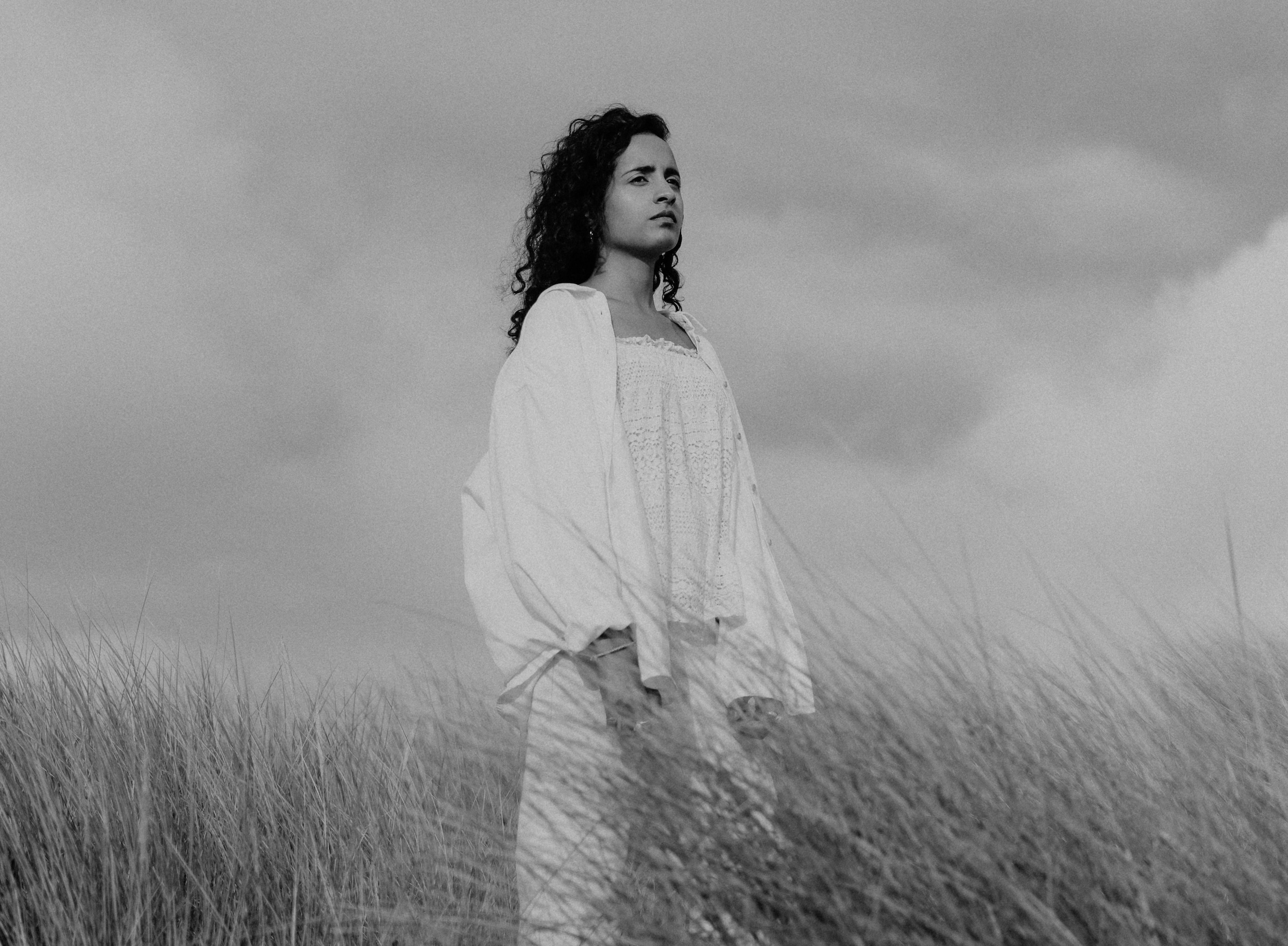
Indie-folk singer-songwriter and producer NAVINA returns with her powerful new single ‘Rain’, a deeply introspective release that explores anxiety, surrender, and the search for inner peace. Known for her poetic lyricism and immersive production style, NAVINA uses this latest track to mark both a return to her folk roots and the beginning of a more refined, purposeful creative chapter.
Built around raw acoustic textures and layered harmonies, ‘Rain’ gradually unfolds into a sweeping, emotionally resonant piece, capturing the turbulence of anxious moments before arriving at a sense of release and clarity. At its core, the song reflects a shift in perspective, embracing the idea that letting go can be just as powerful as holding on.
With growing support from major BBC radio stations and international playlisting success on platforms like Spotify’s New Music Friday, NAVINA continues to establish herself as a compelling voice in the indie-folk space. This latest release further highlights her ability to turn deeply personal experiences into music that resonates on a universal level.
We caught up with NAVINA to talk about the inspiration behind ‘Rain’, the emotions that shaped the track, and how this new era reflects her evolution as both an artist and producer.
–
Can you tell us a bit about your musical background and how you got started in music?
I grew up in a musical family where my mum took me to my first flute lesson (I’m classically trained in flute), and my dad’s tastes in singer-songwriters were always playing in the house. We were always singing songs together, whether it was in the car on a road trip, at church, or my parents always humming something! I was a very shy child; however, I started writing my own music, ironically, on the instrument that I had never had any lessons on, the guitar, at the age of 14, to express myself. I was good at poetry in school, so I was encouraged to turn my poems into song lyrics.
Who are some of your biggest musical influences, both past and present?
Past influences from my dad’s CD collection, which still influence me today, include the likes of Cat Stevens, Paul Simon, Joan Baez, but I also love the Paper Kites, Kacey Musgraves and Noah Kahan. As a producer, I really admire the styles of Rostam from Vampire Weekend, Ethan Gruska and Ryan Tedder.
Are there any specific artists or bands that have had a significant impact on your music style or approach?
Because I think the sonic canvas which Ethan Gruska was able to create in his En Garde album was incredible and something I aspire to, but I’ve also loved the organic yet full layering in the work of the Paper Kites and Noah Kahan’s work. Being a strong conceptual songwriter, strong storytelling, structure and musical arc are important to me, and also serving the listener.
Could you share any memorable moments or experiences that have shaped your musical journey so far?
I think doing my first few live sessions at the BBC was definitely a milestone, and opening for Jorge Drexler (huge fan) at the Roundhouse was something I will never forget when I was a resident artist there. But to be honest, I find the most meaningful things that keep me going are feedback and support from various listeners, messages, people that will buy tickets to my gigs, subscribe to my substack and engage with not just what I’m doing, but why. Ethos is very important to me, so when people engage with that, I feel like my job is done, and it keeps me going.
How do you express your personal experiences and identity through your music?
My music is very deep and an authentic, pure expression of who I am, the experiences I have gone through, but also what I feel I want to say to wider society. Whilst I love producing the actual sonics in the songs, it’s all about the message for me and spreading messages which reshape cultural narratives.
This first release about overcoming anxiety was born out of a very difficult and overwhelming time in my own life, but also was inspired by the narrative of mental health in culture and the label of the “anxious generation” for Gen Z, which I’ve written about here.
I’ve also written songs on various other topics/issues, such as my immigration story, being a first-generation immigrant to the UK, which I’m looking forward to sharing and connecting with others who have had similar experiences, as well as reshaping the narrative around “immigrants”.
Have you faced any challenges or obstacles as a female musician, and if so, how have you overcome them?
I think it’s mainly seen as the lack of platforms and natural networks, which females sometimes miss out on, especially if they have not gone to specific schools/universities. There is also the bias, as an artist, that the industry puts on female artists, but I think the key to overcoming them is to 1) make the most of what you do have and focus on that, not what you don’t. 2) Stay true and authentic to who you are, as I want to build my career on the messages I want to write, not feeling pressured to make music or an image which just isn’t me.
Are there any particular themes or messages that you aim to convey through your music?
Anxiety can be overcome! It is not identity.
The next single talks about immigration, nostalgia and touches on the idea that everyone, at some point, is an immigrant somewhere. Post immigration folk, here we come.
Can you talk about your creative process and how you go about writing and producing your music?
I write spontaneous lyrics that come easily due to my love of poetry. But then it’s about fine-tuning song structure to the core instruments I want to use. I produce everything at home and play all the instruments, so it gives me the flexibility to stretch the sound and sit with each song for longer.
How do you hope your music will resonate with your audience, especially with other aspiring female musicians?
I really hope this message of overcoming anxiety reaches far and wide, that people know that it is possible to find freedom from it, and it’s not through just self-help and “being better” by trying to fix yourself. But it’s through surrender to something greater than ourselves by which we find true healing. As I say, a broken thing can’t fix a broken thing. Anxiety can be overcome, and the experience is not our identity.
–
Listen to NAVINA’s new single ‘Rain’ below.