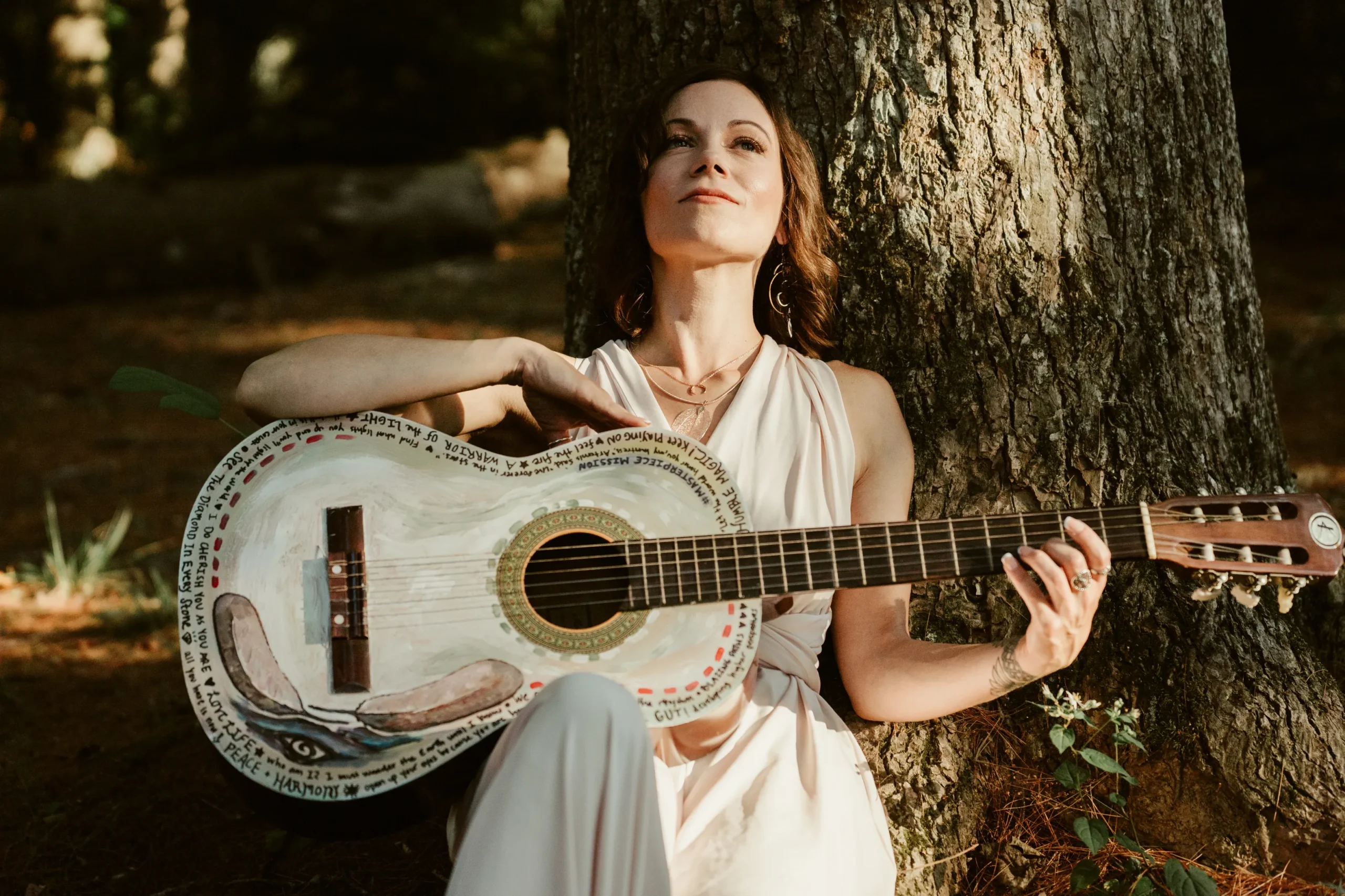
Following the release of her latest single ‘Ancient Vessel’ LOCK Magazine had the pleasure to sit down with Connecticut-based troubadour Kala Farnham to discuss everything ‘Ancient Vessel along with her future plans.
Hi Kala, welcome to LOCK, for our readers could you please tell us a little about yourself?
Thanks for having me! I’m a New England based songwriter who has spent the past three years serving as Connecticut’s 18th State Troubadour. Not many states have a troubadour, so I’m grateful that Connecticut’s Office of the Arts has created this kind of opportunity for musical artists. The State Troubadour serves as an ambassador of music: it’s a role dedicated to promoting culture literacy, engaging the community in the musical arts, and inspiring the next generation of songwriters. During my tenure, I’ve worked to bridge my background in human services and mental health with my passion for music, bringing healing arts programs to communities across the state of Connecticut. Many of the songs that I’ll be releasing this year are a reflection of that work, beginning with my new single, “Ancient Vessel”.
Your latest single ‘Ancient Vessel’ is deeply rooted in mantra-based sound meditation and Nada Yoga. Can you take us back to the transformative retreat that first sparked this song?
Absolutely. Awhile back, I attended a holistic retreat that took an immersive approach to growth and healing. One of the core practices we explored involved recognizing and honoring the different aspects of the self: the body, intellect, emotions, and spirit. Through guided writing, movement, and visualization, we gained an understanding of how these parts interact and how we might bring them into greater harmony. We were asked to take a moment to express gratitude to each aspect of the self for its continued resilience despite the challenges it had weathered. It was a powerful process that left me feeling more deeply in tune with myself, and I came away with a deeper sense of gratitude for the human experience as well as a deeper commitment towards harnessing my strengths to best serve the world around me.
You mentioned the lyrics came to you in a single sitting following a visualization experience. What was that moment like, and how did it shape the song’s meaning?
It was one of those rare, mystical moments where creativity follows effortlessly. During one of the meditations I learned at the retreat, I envisioned a conversation with my inner spirit—my wiser self. That experience was so profound that I felt compelled to capture it in a song, scrawling out the lyrics in a single sitting. I didn’t second guess the words; I simply let them flow. It was the most honest, pure expression of what I experienced in that moment—it felt less like creating something new and more like uncovering something that had always been there, waiting to be heard.
“Ancient Vessel” is a call to honor the resilience of our body, intellect, heart, and spirit amidst life’s challenges. It reminds us that we all carry something greater than ourselves—the wisdom, resilience, and stories passed down through our ancestors. The song asks us to recognize that we are both the vessel of everything that has come before us and the carrier of what will be passed on to future generations. Ultimately, “Ancient Vessel” is an invitation to step into the wisdom of our own body, intellect, mind, and spirit—so we might shape a better tomorrow for generations to come.
The song is being released during Women’s History Month. How do you see it connecting to the resilience and wisdom of past generations of women?
In many cultures, women have historically been primary caregivers of children, passing down stories, wisdom, and traditions to the next generation. Whether through music, story, or the quiet, everyday strength of our role models, so much of that legacy lives within us, often in ways we don’t even realize. “Ancient Vessel” is a reflection of that inheritance. It acknowledges the endurance of women who have carried love, loss, survival, and healing across generations, often without recognition from the history books.
The song speaks to the idea that our voices are part of a larger continuum. When we share our stories, we are contributing to something bigger than ourselves—we’re setting an example for future generations. In releasing “Ancient Vessel” during Women’s History Month, I hope to honor that lineage—to recognize the unseen, unspoken contributions of the women before us and to carry their strength and wisdom forward.
Sonically, ‘Ancient Vessel’ feels both intimate and expansive. What was your vision for the soundscape of this song?
The soundscape of “Ancient Vessel” draws from my study of Nada Yoga, India’s ancient practice of “union through sound”. Nada Yoga often involves singing mantras over a drone instrument, such as the harmonium or tanpura. During my meditation practice, I find the simplicity of the music serves as a grounding force, drawing me more deeply into the present moment and into a place of intentional self-awareness. So I wanted to reflect the simplicity of sound-based meditation through the intimate, drone-like guitar and piano accompaniment and the mantra-like refrains in “Ancient Vessel”.
At the same time, I wanted to sonically embody the song’s expansive themes—the interconnection between our ancestors, ourselves, and future generations. The song begins with a solitary vocal and gradually builds into a chorus of harmonies, supported by the primal drumming of Jimmy Nutt and haunting pedal steel of Stephen Peter Rodgers. Even the recording process—tracking the foundations of the song in my countryside home studio and completing the process with artists from my wider community—mirrored the balance between intimacy and expansiveness at the heart of the song.
Your work often merges music with healing practices. How has your background in human services and mental health shaped your approach to songwriting?
My work in human services and mental health has given me a deep appreciation for the power of narrative medicine—the healing that occurs when we share or hear stories that reflect our deepest truths and shared humanity. Music, in particular, seems to access emotions that words alone can’t always reach. It allows us to process experiences that might otherwise feel inexpressible.
A few years ago, at a songwriter’s intensive with the Johnny Mercer Songwriters Project, I received a piece of feedback that has stuck with me: “Write what you’re afraid to write about”. Our mentors encouraged us to reach into the deepest parts of ourselves, to write about the things we had never given voice to. The songs that emerged from each songwriter were deeply personal yet profoundly universal—they really made an impact. That experience, in addition to my work in human services, has solidified my belief in the power of honest storytelling. It shapes who I am as a songwriter today.
How do you see music as a tool for personal and collective healing?
I’ve believed in the healing power of music for almost as long as I can remember. When I was young, storytelling and songwriting were a sanctuary for me, a safe space where I could make sense of life’s hardships and write my way through to a silver lining or the light at the end of the tunnel. When I first performed an original song as a teen, I witnessed how music could be a source of collective healing after a meaningful connection with an audience member.
That moment stayed with me and deepened my understanding of music as more than just self-expression—it’s a bridge between people, a way to translate emotion when words fall short. In recent years, my work as Connecticut State Troubadour has expanded my appreciation for how music can unite communities in shared healing. Over the years, I’ve witnessed again and again how music can offer solace to those in grief, courage to those facing uncertainty, and connection to those who feel alone. Whether I’m facilitating a sound meditation, a folk sing along, or working with students to build confidence in their voice, I’ve seen how music can break down barriers, bring both peace and empowerment. The experience of music, in both solitude and community, has the power to transform us through reminding us of our resilience and our shared humanity.
You’ve performed in diverse spaces—from folk clubs to recovery homes. How do those different settings influence the way you connect with your audience?
Performing at recovery homes, assisted-living facilities, and other healthcare settings is a beautiful example of music as a medium of connection. Watching someone’s face light up as they hear a familiar melody, witnessing nonverbal patients singing along—moments like that are incredible to me. In these spaces, I see music as an invitation rather than a performance—inviting the audience into a shared and collaborative musical experience.
I carry those experiences with me in concert settings, doing my best to approach audiences with an open mind and a willingness to learn. To me, live music is always about connection over showmanship. When I perform in folk clubs, I love having the opportunity to chat with audiences afterwards—hearing which songs resonated and what moments from their own lives the music brought to mind. Sometimes a simple “thank you for seeing me” says everything. That moment of connection, of seeing and being seen, being a mirror to one another—it’s powerful.
You co-founded Bigger Beast Records to support independent songwriters. What inspired you to take that step, and what impact do you hope it has on the music community?
In recent years, my career has involved a lot of hands-on work in the local arts scene striving to help emerging artists find their voice and create community spaces for the arts. My co-founder, Frank Viele, came from the other side of the industry: he spent years mastering the ins and outs of the music business, learning from the pros. He has real industry expertise. I think in many ways we had a shared vision, but it wasn’t until we joined forces that it all clicked. What started as a booking agency has evolved into an organization dedicated to collaborating with non-profits to create impactful fundraising campaigns through music, as well as helping artists to grow their careers.
At its core, I think Bigger Beast is about shifting the culture of the music industry—creating a space where artists can support one another at each stage of the journey rather than compete. We’re working to build something truly collaborative—a network of resources, a passionate support team working behind the scenes, and, most importantly, an artistic community. We want musicians to know they don’t have to go it alone. When we work together and uplift one another, that’s where the real magic happens.
Looking ahead, your upcoming album explores themes of resilience and empowerment. How does ‘Ancient Vessel’ set the tone for what’s to come?
In many ways “Ancient Vessel” is the heart of the album. It introduces the central themes of transformation, endurance, and healing. Each song expands on these themes, stepping into the lives of different characters: An author’s bond with his writing studio, a young man reflecting on his grandmother’s wisdom, a modern-day Red Riding Hood, a woman revisiting her childhood home. Each story dives deep into the human experience. “Ancient Vessel” lays the foundation, inviting us to embrace our own stories while recognizing our place in the larger human family.