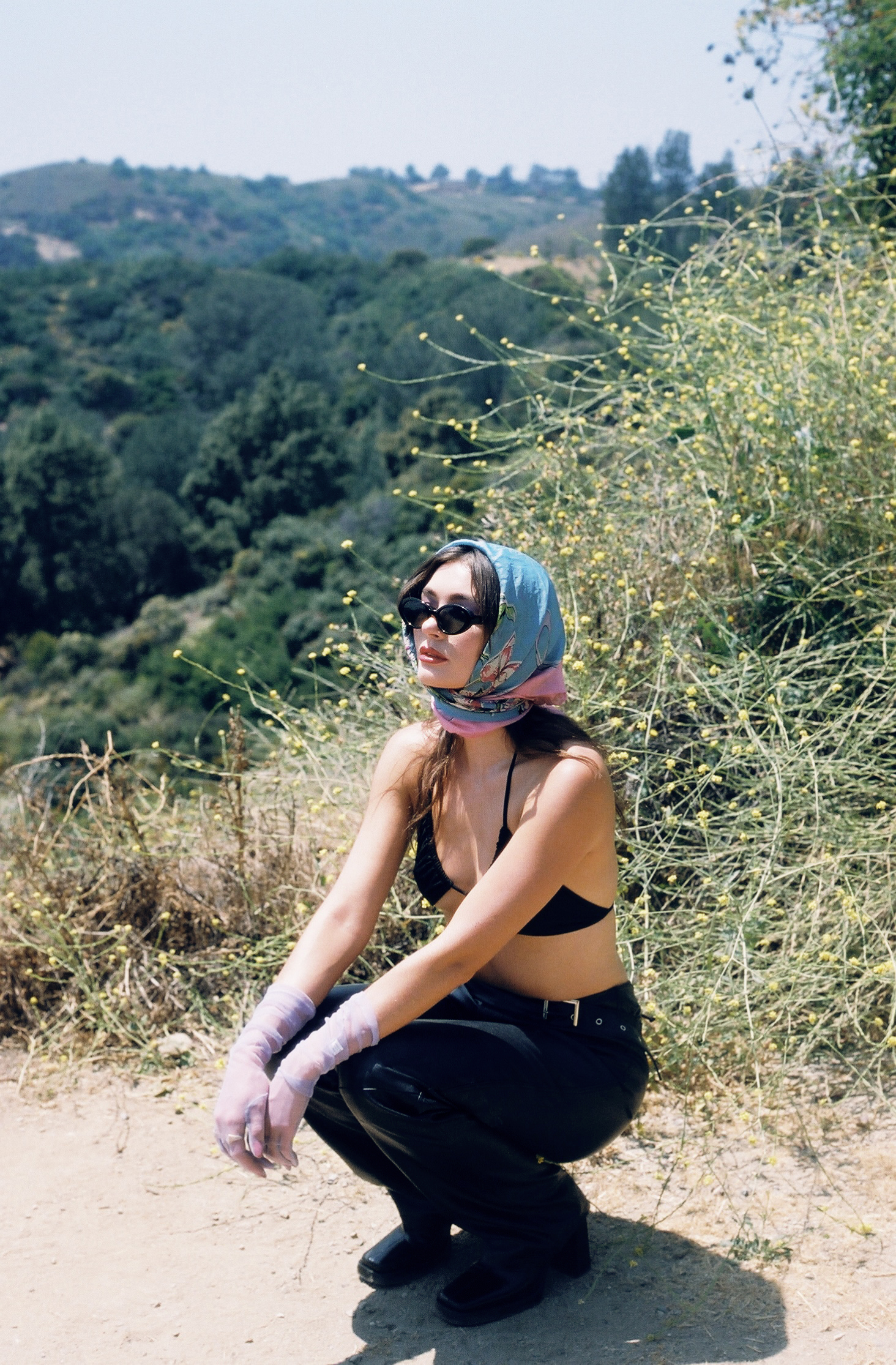
For Georgia VanNewkirk, a song is never just a song. As a musician, photographer, creative director and visual storyteller, she builds entire worlds around her releases, blending vivid imagery with emotionally honest songwriting that feels both cinematic and deeply personal. Her latest single, “CRUSH”, captures the intoxicating rush of possibility that comes with a new connection, embracing the fantasy, excitement and hope that exist before reality has a chance to intervene.
We caught up with Georgia to discuss the inspiration behind the single, the relationship between her music and visual art, and why some of life’s most meaningful experiences don’t need to last forever to leave a lasting mark.
1. You’ve described “CRUSH” as being inspired more by a feeling than by a specific person. Do you find yourself writing about emotions first and people second?
I think I’ve always written about emotions first, even when I’m writing about a very specific person. The person is usually just the doorway into a feeling I’m trying to understand.
With CRUSH, the person was obviously real, and the details were real, but what I was chasing was that feeling of possibility. That moment where someone hasn’t disappointed you yet, where your imagination gets to fill in all the blanks. I think that’s why the song feels bigger than just a story about one person. Everyone knows what it feels like to be caught up in the fantasy of what something could become.
The older I get, the more I realize that the tiny, specific details are what make emotions feel universal. The bar, the orange wine, the way someone looked at you sitting in your passenger seat; those little moments are what unlock the bigger feeling.
2. This song arrived while you were working on much heavier material. Did writing something joyful and carefree change the direction of the wider project in any way?
Absolutely. I think CRUSH was the moment I remembered that healing isn’t always this dramatic, devastating process. Sometimes it’s laughing with your friends, getting caught in the rain, feeling excited about someone new, and remembering that life can be fun again.
The project started in a much heavier place because I was processing the ending of something really significant. But CRUSH became this little window of light in the middle of it. It reminded me that even after heartbreak, you don’t become a different person. You’re still capable of being hopeful and completely swept up in something.
I think it actually made the project feel more honest because life is never just one emotion. Even in your saddest seasons, there are still moments where you get butterflies over something completely irrational.
3. As someone who directs, photographs, styles, and designs your own visual world, do the images for a song usually come to you before the music or do they emerge once the song is finished?
It really depends on the song, but with CRUSH, the visual world existed almost immediately because the song itself felt like a movie in my head. I could see the scenes as I was writing it.
I think I naturally process music visually. I don’t just hear a song; I see the colors, the lighting, the clothes, the camera movements, the little details that make up the world around it. Sometimes the visuals align with the story, but in the case of CRUSH, the visuals are just an emphasis on the whimsical nature of the song.
For me, the visual side isn’t separate from the music. It’s another way of telling the same story.
4. “CRUSH” embraces the idea that not every connection has to last forever to matter. Has that always been your outlook or is it something you’ve learned over time?
Definitely something I’ve learned over time. I think when I was younger, I measured experiences by whether they lasted. There was this idea that if something didn’t become permanent, it somehow wasn’t meaningful. Now I think some of the most important moments in our lives are the ones that weren’t built to last. A summer romance, a friendship, a conversation with someone you never see again. Those moments can completely change you. CRUSH is really about appreciating something while you’re inside of it instead of trying to immediately figure out where it’s going. There’s something really beautiful about letting a moment just be a moment.
5. Your work often feels cinematic, even in its quieter moments. Are there filmmakers, photographers, or visual artists who influence the way you build the emotional world around your music?
I’m really drawn to artists who can make something feel nostalgic and emotionally specific at the same time. I love filmmakers who make you feel like you’re watching a memory rather than just a scene.
I’ve always been inspired by Petra Collins, Sophia Coppola & Nadia Lee Cohen because they embrace camp while still creating art that is incredibly human. They see the world in a way that is uniquely theirs and I’ve always been drawn to that kind of world building.
6. You grew up between Los Angeles and Charleston, two places with very different creative energies. How have those contrasting environments shaped your identity as both a musician and visual artist?
I think growing up between those two places gave me a really interesting balance. Los Angeles taught me to dream big. Both of my parents worked in film, and they showed me this constant energy of possibility from a very young age. In LA you’re surrounded by people chasing their weirdest, most specific ideas, and that’s incredibly inspiring.
Charleston gave me the opposite. We moved to a small neighborhood with a cul-de-sac, and I was able to find my own way as an artist in a relatively quiet place. It created an appreciation for the beauty in small moments.
I think my work lives somewhere between those two worlds. There’s the cinematic, ambitious side of LA, but there’s also the nostalgia and intimacy of the South. I’m always trying to capture both. Something that feels expansive but still deeply personal.
7. You approach every release as a complete creative world rather than just a song. When listeners step into the universe of “CRUSH”, what do you hope they leave with once the music ends?
I hope they leave feeling a little more open. I think adulthood can make us feel like we have to be logical about everything; relationships, choices, emotions etc. Sometimes we forget how fun it is to just let ourselves experience something. The world of CRUSH is about romanticizing your life a little bit. Not in a way where everything has to be perfect, but in a way where you notice the small moments that make life feel magical. I hope someone listens and becomes a version of themselves that is a little more fearless and excited about what could happen next.
8. If “CRUSH” captures the excitement of possibility, what emotional chapter are you most interested in exploring next through your music?
I’m really interested in exploring what happens after the fantasy fades. Not necessarily in a negative way, but in the moments where you have to come back to yourself. CRUSH is about the beginning of something, that rush of possibility and imagination. But I think the next chapter is about identity, growth, and figuring out who you are outside of the people you love or the stories you create around them. I’m interested in writing about becoming more comfortable with uncertainty, with change, with letting things evolve naturally. I think there’s a lot of beauty in that space between who you were and who you’re becoming.