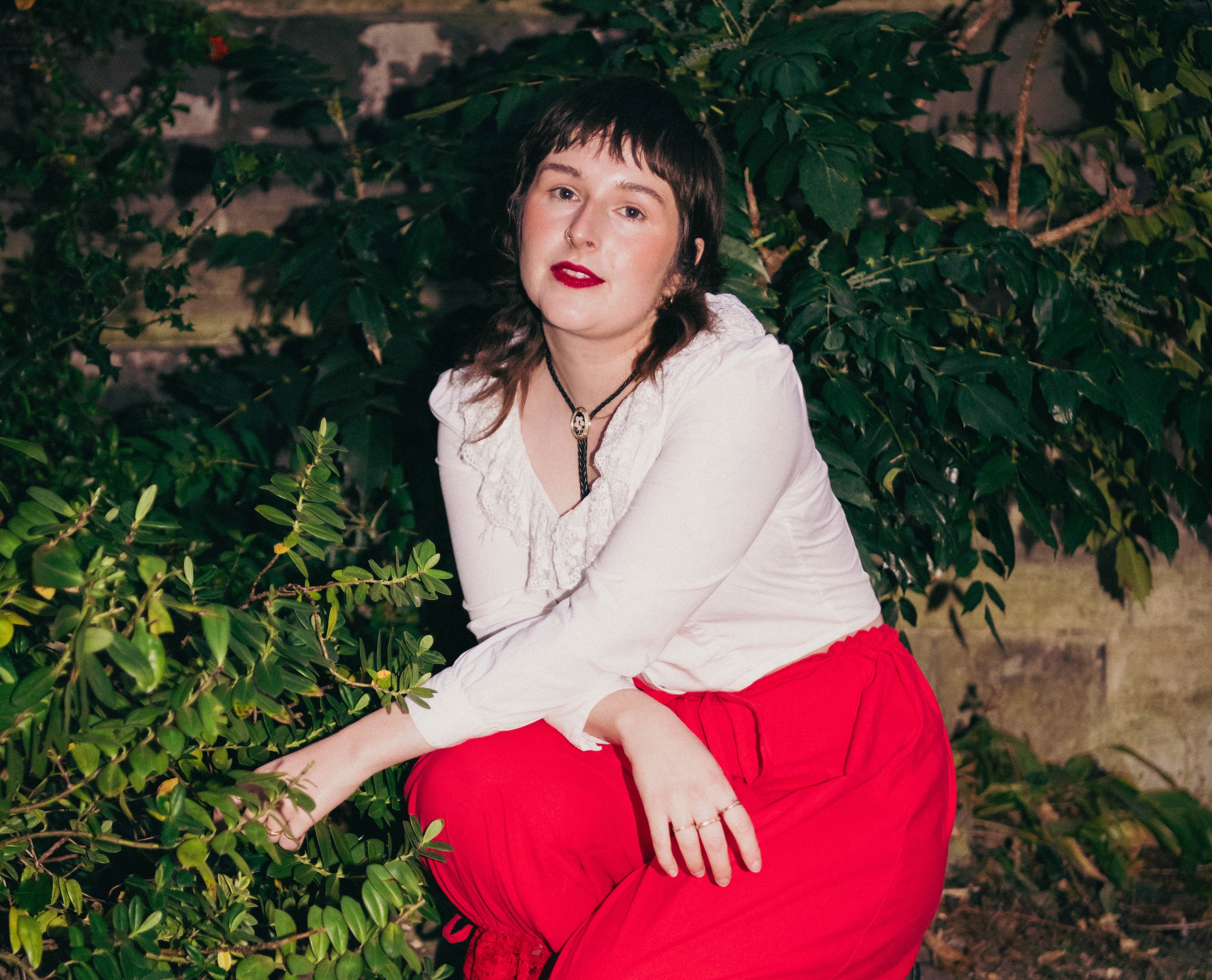
If there’s one thing Essy Sparrow doesn’t do, it’s play it safe. The folk-pop firestarter, once dubbed a “scrappy little songwriter” for her brutally honest lyrics and DIY ethos, has returned with her most personal release yet. Her new single ‘Footnote’ is a reckoning with her past, the feeling of being othered, and the need to take up space in a world that once told her to shrink.
Raised on a rural commune in the South West of England, where even phone signal was a luxury, Essy’s early musical diet was made of cached Laura Marling videos and school WiFi scavenges. Now, years later and on the other side of that isolation, she’s sharing her story through vivid songwriting that burns slow and bright.
We caught up with Essy Sparrow to talk about her influences and what has inspired her sound most over the years.
–
Can you tell us a bit about your musical background and how you got started in music?
I grew up in a rural commune in the South West of England with no phone signal and very slow internet, so I found a lot of solace in learning to play guitar and making art. Making and producing music came much later. I felt like I had a lot of air to clear before I could really write songs, I often wrote poems through my 20’s and then when I moved back to the coast after 10 years in the city I found that songwriting opened up to me and I felt ready to finally write and play more. My first EP was produced by my long time friend Jemima Coulter (Hailaker) and that felt like a soft place to start putting out music, that came out a year ago this November and here we are now.
Who are some of your biggest musical influences, both past and present?
I think for me the common thread around the music I love is nostalgia, I grew up on the music of Laura Marling and James Taylor and 80s synth celtic folk bands like Capercaillie but in my teenage years and 20’s I fell deep into the indie genre – bands like Hailaker came to the forefront and then during the lockdown I, like everyone, loved Folklore and Evermore by Taylor Swift. Now looking back you can see flickers of all the influences in the music I make and it’s a patchwork quilt of nostalgic, storytelling folk songs with flickers of modernity that bring it into the present day.
Are there any specific artists or bands that have had a significant impact on your music style or approach?
Since becoming a musician and artist a lot has changed in terms of who I find inspiring, now it feels a lot less about just the music and more about the project as a whole. I feel super inspired by artists that give themselves to all sides of their work, Chappell Roan of course, Erin Le Count and even creators that aren’t music artists like Jessie Cave (Playwright) who really world builds around her creative projects has really inspired me.
I’m also incredibly inspired by artists that have carved their own path and challenged industry norms Orla Gartland, Nina Nesbitt, Gabrielle Aplin, Sarah Kinsley, all artists that have in one way or another chosen to go against the grain and run record labels, produce their own music and take back control around their artistry.
Could you share any memorable moments or experiences that have shaped your musical journey so far?
I’ve had two moments this year that shaped me hugely.
At the start of 2025 I wrote down two goals, one was to play Boardmasters and one was to support Semler (my favourite artist) – both of these felt lofty and almost unachievable and yet both have happened this year!
I think playing Boardmasters this year with BBC Introducing was a true pinch me moment, it
felt like so much of the work I’d done around my art had bought me to that stage. I really wanted my performance to feel memorable and different so I bought two of my friends to be my backing dancers, I did an on stage costume change and the Boardmasters team dropped the stage backdrop so you could fully see the sea behind me as I was performing. It was truly special. I still can’t believe that happened.
As for supporting Semler, their work inspired my debut EP “Still Upset About It Actually” and so to open for them honestly was one of the most dear experiences to me of all time. I drove 8 hrs up the country to play and they were incredibly kind and bought me a drink and chatted about music with me after the show. I also felt like I found my voice more in that gig. I’ve always had a bit of vocal anxiety because I’m a writer at heart as opposed to a singing-first performer, but the audience really responded to my set, purely because the themes in mine and Semler’s work are quite similar. I found that it allowed me to sing with more confidence than ever before. I felt my voice change and open and I thought “oh this is different, try to bottle how this feels in your body and take it with you wherever you go”. So I’m grateful to Semler for having me on tour, I like to think I have that feeling bottled and with me forever now.
How do you express your personal experiences and identity through your music?
I remember seeing an interview with Lizzy Mcalpine last year where she said the truest way to be unique is to be yourself and that’s something I’ve found to be incredibly true with music. No one can truly replicate or copy something if it’s genuinely founded in who you are.
For me, I spent a lot of my life not feeling cool enough, feeling like the music industry was a place for edgy people looking into the middle distance singing ambiguous lyrics and being deep and unknown. This always felt super opposite to who I am as a person. I love to laugh. I love to look at issues head on and say things how they are. I find it impossible to be illusive. I love trying hard. I love all the music and films that many people would describe as “cringe” and “basic” and I’m not ashamed to yap about the joy that those things bring me. So my music and the live performances emanate that energy for sure.
My music is super considered, and full of storytelling, lyric therapy and whimsy, so my shows are too.
When you come to a show we start with a free craft workshop before the support act, run by a local maker.
We’ve made banners, zines, mini-books and basically built a community around the experience of a show which can so often be a solo experience or even an anxiety inducing experience for some people. I also have my friends backing dancing for me and heaps of crowd moments. One of my songs “are you too ashamed to call?” is inspired by a scene from Little Women where Laurie proposes to Jo and she says no, so we have an audience member come up and we act out that scene during the final verse. It brings the whole thing to life.
Have you faced any challenges or obstacles as a female musician, and if so, how have you overcome them?
I’m very new to this journey, but it’s very difficult as a complete newbie to fully understand how the industry works as it is very gatekept and I think that’s an issue for all marginalised groups. My mindset has always been to make things happen for yourself and if the industry isn’t helping you, then do stuff without them till they take notice. Be underestimated until you’re undeniable. I think social media has been my secret weapon in a way because I don’t have the connections that some artists might have, but by really using socials I’ve been able to build my music and have direct to fan communication which has helped me to build momentum around my work. Through socials I’ve been able to have 9 million views on my music on tiktok which is pretty mindblowing and that’s without any industry help, no manager, no label etc. I feel so grateful to anyone that’s discovered my work there and it’s felt like a somewhat quiet rebellion to continue building your artist project directly to fans instead of waiting for someone to notice you.
Are there any particular themes or messages that you aim to convey through your music?
My music feels nostalgic and whimsical, I like to take my work seriously but not myself and I think that comes across in my music and the storytelling around it.
Can you talk about your creative process and how you go about writing and producing your music?
I often start writing as poetry. Since I was young, I’ve practiced stream of consciousness poetry writing. I’ll often put on a 2 minute timer, pick a theme and just write, I find that it really helps me draw out themes, lines and ideas that then I pull into songs to take shape.
For production I love working collaboratively and seeing what each new producer brings out of my work. Working with Jemima Coulter was truly special as a friend but also because they’re an artist who’s work I’ve always loved and the same with Grace Gardner. Grace’s work soundtracked my past couple years so to see what they brought out in Footnote was truly special. We worked overseas and across timezones sending demos back and forth until we found the sound and in that we formed a friendship too which has been really special.
How do you hope your music will resonate with your audience, especially with other aspiring female musicians?
I really hope that people hear it and it can make them feel seen. Once I played a song to a friend and she said “oh my gosh I thought I was the only person that felt that way” and I thought “that’s why I make music”.
–
Listen to Essy Sparrow’s new single ‘Footnote’ below.