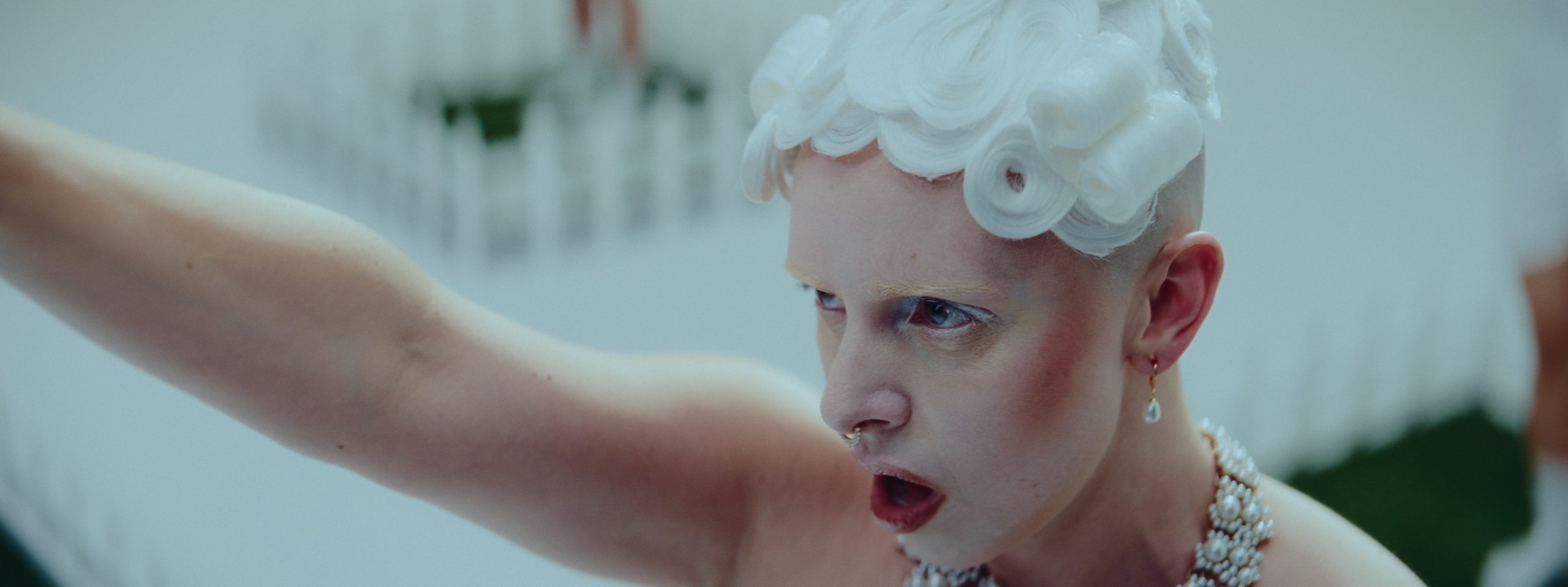
For Callie Crofts, finding her voice has meant learning to stop asking permission to use it. As the frontwoman and songwriter of Salt Lake City art-pop band Die Shiny, Crofts has spent years turning vulnerability, queer identity, political frustration and collective experience into music that refuses to make itself smaller or more comfortable for its audience.
That spirit runs through Die Shiny’s latest single, “Gold Star, Good Citizen”, an urgent anti-anthem written in a single morning and performed at a political march just days later.
We spoke with Callie about trusting her instincts as an artist, the strength of Salt Lake City’s counterculture, the risks of being loud and visible, and why joy and community can be just as powerful as anger when it comes to imagining a different world.
- As a songwriter and frontwoman, have you ever felt pressure to soften your voice or make your message more “palatable” and how have you learned to trust your instincts instead?
I’ve been writing since I was 12 years old, and I struggled for most of my life as a people-pleaser, so YES. I’ve been through several years of working hard to re-program myself to take up space, to speak with power and confidence, and to advocate for myself without constantly monitoring how palatable I am.
- “Gold Star, Good Citizen” was written in a single morning and performed at a protest just days later. What did that experience teach you about the role music can play in moments of collective action?
I’ve never thrown something together that fast to perform it live, I generally like things to feel finished and polished, but this song was too right for the moment. Performing at a political march is a rare opportunity, so I wanted to make the most of my moment with a microphone. Music is a deeply effective form of non-violent resistance in my opinion. When considering my job as an artist in a country that has fallen into fascism, I always think of the quote from Toni Cade Bambara – “the role of the artist is to make the revolution irresistible,”
- Die Shiny’s music often balances vulnerability with defiance. As a woman writing politically and emotionally charged songs, how do you navigate the tension between being open and protecting yourself?
Honestly, there is no protection. Yes, I am a woman, but I’m also non-binary and gender fluid. Being confident and loud and visible doesn’t feel safe to my individual body and self, but the alternative is worse. If my community collectively decided to be invisible, so much would be lost. The work that queer and feminist artists do is to take on personal risk in the name of collective power.
- Salt Lake City isn’t always the first place people associate with progressive art or queer culture. How has building a creative community there shaped both you and Die Shiny?
Salt Lake City is a progressive oasis in a red state. Most outside of our state probably don’t know how strong and vibrant our counter-culture is. The pressure surrounding us strengthens us, and we create and love and connect like our lives depend on it. There is so much power in our creative community here.
- A fan jokingly suggested you write “the new national anthem” and you ran with the idea. What does a modern anthem sound like to you, and whose voices do you think deserve to be heard more loudly today?
I saw that comment shortly after I had written the song, and I thought “little does he know…” haha. My song is like an anti national anthem. I am not proud of my country. Every bit of patriotism that I’ve ever felt has melted away in the fires of genocide. As a white American and a person with Mormon heritage, my forefathers and ancestors violently erased and displaced entire cultures. That being said, if someone is going to craft an actual anthem of voices that MOST deserve to be heard, I’ll be in the audience cheering them on as an ally – they are the Indigenous, Black, and colonized artists of the world.
- You’ve built a reputation for turning difficult subjects into cathartic live performances. Do you think joy can be just as powerful a form of resistance as anger?
Absolutely. Joy is just as integral as hope is to the revolution – not as an escape from reality, but as a driving force for people to take their power. We need to simultaneously create and fight for the world we wish to live in.
- Looking back at when Die Shiny first formed in 2019, what’s one piece of advice you’d give the younger version of yourself about finding your voice and taking up space as an artist?
Trust your damn self. Do not pander. Do not compromise. And give yourself a break, darling – You’re fabulous and you’re going to be just fine.
- LOCK celebrates women who are shaping music on their own terms. What does success look like for you now, beyond streams, reviews, or industry recognition?
Success to me is having my own community – not relying on gatekeepers to give me access to the humans who connect with my art. I’ve spent several years learning DIY business and digital marketing skills all by myself in order to build my own world without needing a label. It’s finally working, and I could not care less about my stream and view counts, because real people are buying my CDs, coming to my shows, connecting in my inbox, and powering my art.