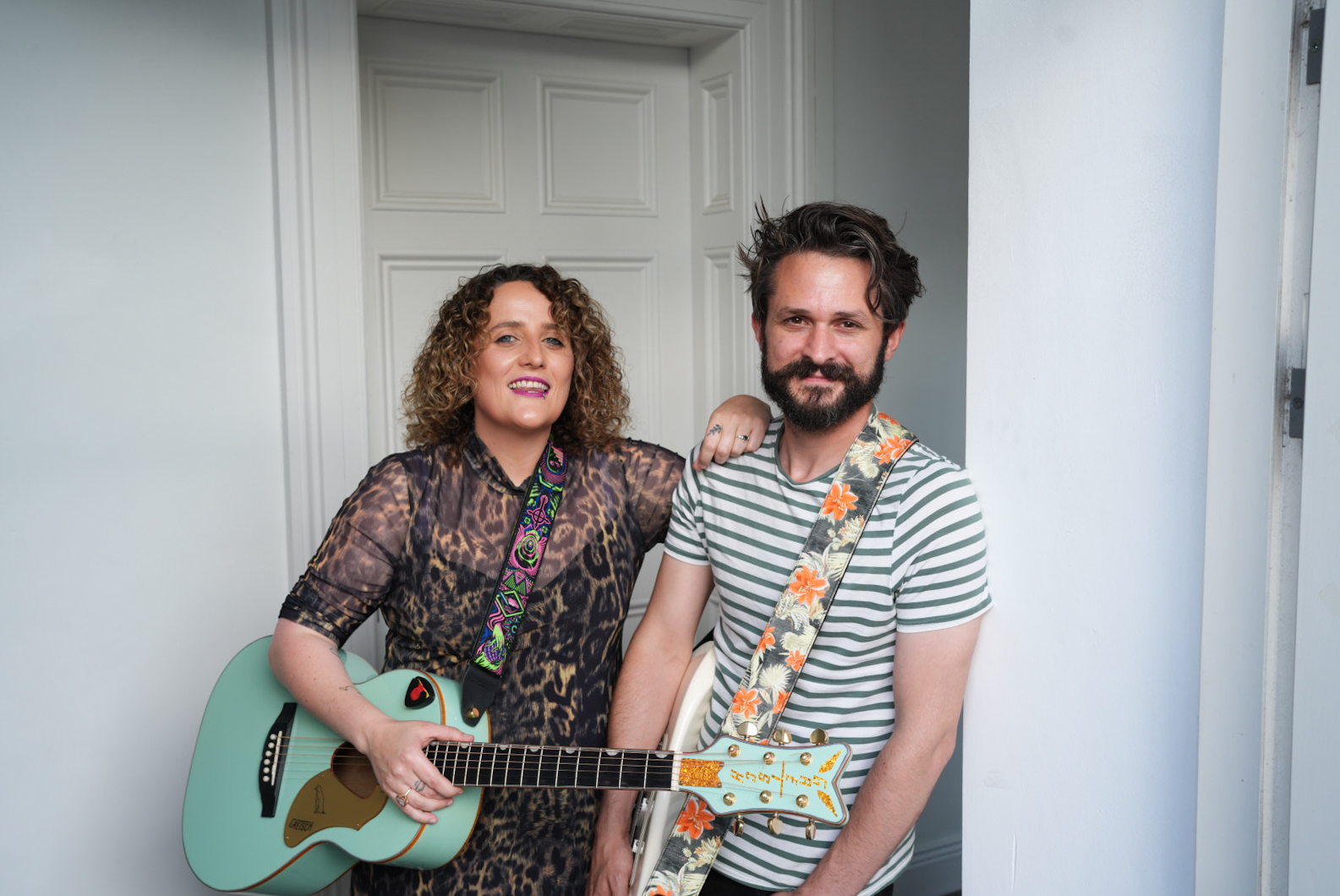
You’ve said the name Graceless began as a joke about never feeling polished enough. When did that joke become something more empowering?
I called myself it, as a bit of a laugh. I’ve never been the most graceful person, in movement or in mindset. My brother is four years older than me, and I idolised him growing up. In our band in secondary school, he wrote the songs and played guitar, and I was the voice. Even later, when we were all writing, I still saw myself as just a voice, reliant on others to give my artistry weight. When Staring at Lakes came to an end, I was just Grace, without a band, and that felt like less. I’d lost my identity and my purpose. Then a friend pushed me to play my own songs at his venue, just for friends. The first gig as Graceless was an open mic in the Workman’s Club. I’d told about three or four friends and no one else. It was just me, my loop pedal and four songs, and I got a standing ovation. I didn’t know where to look, I was so uncomfortable, haha. I went home that night and let it percolate a bit and thought, hey, these songs are good, there’s more here. So I put a post up on Instagram looking for a guitar player, and Richie got in touch. We’d jammed for six practices back in 2017 and never saw each other again. His confidence in my songwriting pushed me to finally have some in myself. I came to realise: I am Grace. And I am talented. I just needed to own it and step out. Now the name is my stamp of approval. A quiet kind of defiance. A declaration that I’m an artist, a musician, a singer, and a mess.
Your debut EP is four songs, four chapters, beginning in grief and ending somewhere much more exposed. What story were you trying to tell?
Honestly, I wasn’t trying to tell one. I wrote all four songs in the same period, each as a standalone, and only when I listened back to all four together did I realise it was one story: me confronting myself. The Raven is my past, crawling out of something dark. God’s Plan is my beliefs. I started writing it in a pew at a family funeral, while the priest gave a “repent, sinners” sermon that was like something out of South Park. In Ireland the Church controlled schools, hospitals, everything, and a friend back home in Tipp couldn’t get her child into a good school because she hadn’t baptised her. Around the same time, Notre Dame burned and billionaires pledged fortunes overnight to rebuild it, while causes that actually matter go without. The song gives out about all of it, and about how religion gets used to justify war. Underwater is my darker habits. And Pillow Talk is my shyness around love. I won’t say it ends somewhere brighter, but it’s lighter. Short and sweet, still exposed, just not as darkly.
Pillow Talk is described as a song for people who are bad at having crushes. Are you bad at having crushes, and what made you want to write about that quiet moment after intimacy?
Absolutely, I’m bad at crushes. I’m very independent and content being single, and that’s probably been the biggest thing holding me back. When I was younger I enjoyed being free, and I see nothing wrong with that, but as you get older you realise it’s better with real intimacy in it. Pillow Talk is about a crush I never let the other person in on. I wrote it in about half an hour, daydreaming about them. What I really wanted was the bit after: the chats when you’re lying there and start to actually know someone. It made me realise I want someone to share the pillow talk with, not just the night.
Underwater explores choosing to stay submerged rather than climbing out. Have you ever recognised yourself in that feeling?
Oh, absolutely. Rue’s depressive stage in Euphoria, I related to that so much. You’re watching mind-numbing TV, you know it’s shit, but your brain needs the bed rot. And there’s something comforting down there. It’s quiet, and nobody needs anything from you. Underwater was written in one of those phases. I was having a “me” weekend but felt anxious and unsettled, woke at 3am, and the chorus lyrics just poured out into my bedside journal.
You’ve turned not feeling “polished enough” into a kind of creative manifesto. What does embracing imperfection mean to you, both in music and in life?
Graceless is my truth. It’s the act of shaking off self-doubt, an ode to being imperfect, unfinished, a little rough around the edges, and entirely worthy of being heard. That’s the theory, anyway. Life is the harder one. We joke in my family that I got my fairy godmother Noreen’s genes. She’d be up a ladder at midnight if there was a crack that needed painting, or out with the scissors trimming the edge of the grass. If something gets in my head, I have to do it immediately. There’s no leaving it on the long finger. I could have had the most stressful week at work and a few busy nights prepping band stuff, finally get a Sunday off, and I’ll use it to paint a bloody gate rather than sit down.
Music is where I’m learning to let go. It’s my release, the space where I feel free, so I’m trying to enjoy it rather than get lost in the stress of it. If I write a song and I love it, that’s what matters. If nobody else does, that’s OK. A song can be imperfect for a while before it sits right. We jam it, play it live, see how it lands and tweak it as we go. The lads would probably say I’m still an absolute perfectionist at rehearsal, but I think I’m getting better. And that feeling when we all know a song has landed in the room? That’s the magic.
You balance a demanding day job with making music. How do you protect the part of yourself that needs to create?
Honestly? I think the part of me that needs to create protects me, not the other way round. It’s my only way to unwind, clear my head and feel free. When I get to sing and get lost in it, that’s me at my peak.
I won’t lie, the balance is hard. Some evenings the last thing I want is to pick up a guitar, and other evenings I need to, just to get the stress out. We practice every Wednesday night, and without that my week would be work, eat, sleep, repeat.
The last two months have been chaos. We released the EP on 6 November. I did the artwork, sorted the vinyl, booked the venue and support for our launch at The New Theatre, which has sold out, and we shot a music video for Pillow Talk. I came up with the concept and edited part of it myself, and I had to run to three different Dunnes Stores for a feather duvet!!! Don’t ask. The admin kills the vibe more than the day job does. You can close the laptop on the day job, but the admin happens after it, squeezed in around the creative bits.
Getting an Arts Council Agility Award this year has helped me build my production skills, so now I produce at home in my own studio. It’s still a laptop, but I can send the lads a proper demo instead of a voice note.
What advice would you give to a woman who feels she has to be fully ready, qualified or polished before she allows herself to start?
Jump in. Start before you feel ready, because that feeling might never come. I waited years to stand up on my own. In my last band there were three of us writing, so none of us ever got to take up full space, and I told myself I wasn’t a good enough guitarist to play. Graceless only happened when I stopped waiting. Record the songs, put them out, and fix things as you go. Would an average white man hold himself back? The church of Florence said it best in “One of the Greats”: “It must be nice to be a man and make boring music just because you can”. Exactly.